Visit

www.timeintuscany.com Alvina from Podernouvo has agreed to write some posts about the food from Tuscany.

Simple Conversions - Liquids - 1 cup / 250 ml / 8 fl oz Solids - 20 g / 1/2 oz; 125 g / 4 oz; 500g / 1 lb C to F - 120C / 250 F; 180 C / 355 F ; 200 C / 390 F mm to in - 1cm / 1/2 in; 5cm / 2 in Boneless meat or chicken - 450g /1lb
Showing posts with label antiageing food. Show all posts

Saturday, October 13, 2018

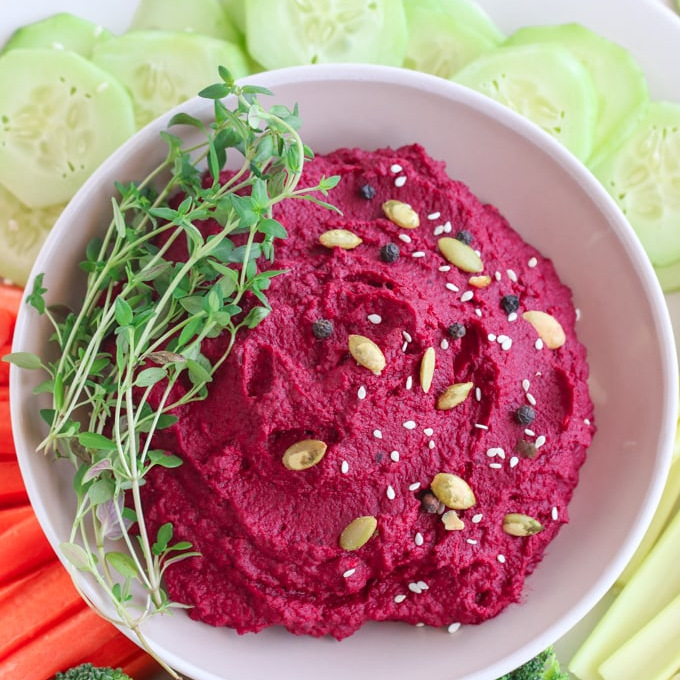
Beet and Hummus dip enlivens a Meza Plate


Colourful addition to a shared platter
Beet Hummus Dip

This quick, healthy dip can be made with pre-cooked or pre-roasted beets. Dukkah or Za'atar adds a Middle Eastern flavour.  Alternatively, roasted nuts and seeds of your choice or fresh herbs can be used.

Combine the following in a food processor until creamy but with some grainy texture.  If not using tahini you may need to add a little water.
1 can - 400g,
 chickpeas, drained & rinsed; 2 medium cooked, quartered beetroots; 2 cloves garlic, juice and zest from 1 medium lemon; 2 tbsp olive oil, 1/4 tsp salt, 1/2 tsp ground cumin, 2 tbsp tahini (optional even though it adds a lovely nutty flavour)


Sprinkle liberally with Dukkah or Za'atar. Serve with toasted flatbread or pita. 

Beetroot hummus will keep in the fridge, covered, for 4-5 days. 
ALFRESHCO Hint


What is the difference between Za'atar and  Dukkah?


Dukkah

Za'atar is a mix of crushed herbs like oregano, thyme and toasted sesame seeds with added sumac or marjoram. This is delicious over hummus, beans, eggs or vegetables. 
Dukkah is a textural treat blending nuts such as pistachio, hazelnut or almond – with cumin, toasted sesame and coriander seeds for a little kick.

Monday, February 18, 2013

Walnut Pesto Pasta is a Tuscan favourite


Alvina's Bell at Podernuovo is calling me to lunch - happy memories!

Pesto is a favourite subject of mine. This year, in my Mosman garden, one punnet of basil planted here and there, yielded constant harvest of a favourite, aromatic herb.

Traditionally Pesto is made with pinenuts - perhaps they were plentiful in Italy but they still had to be super labour intensive! Have you seen the way they have to extract each little precious pinenut. An alternative is Walnut Pesto which evolved from the need to find ways to use the walnuts which drop from the old walnut trees on the property.


We worked in the fields with Umberto, doing what needed to be done - digging out stones, picking grapes, making wine etc.

I cut the lavender and rosemary back before winter - I had helped to plant it a few years ago but since everything grows so quickly it needed cutting back.

Alvina's bell is a suspended bronze bell which she rings when lunch is ready. She has tended the vegetable garden, harvested its bounty, applied her endless creativity, and the call of the bell means that a delightful lunch awaits. We eat, exchange experiences of the morning, make plans for the evening meal (everything revolves around food of course) then retire to our villa for siesta - maybe to doze or perhaps to read the current novel which was being circulated.

Alvina's Walnut Pesto Pasta (to be served with tomorrow's Fennel and Orange Salad)
Serves 4
400g (13oz) cappellini or angel hair pasta - sea salt and black pepper to taste
Pasta comes in different shapes and sizes like angel hair or capellini, fettuccini, fusilli, linguini, macaroni, spaghetti, etc. Capellini or angel hair pasta are long strands of pasta that are commonly used with light sauces.
Pesto
Large bunch fresh basil leaves
2 cloves garlic
1 large handful chopped walnuts
extra virgin olive oil
1/2 cup grated parmesan cheese

Shred basil leaves and place in a blender with crushed garlic, walnuts and about 2 tblsp olive oil. Puree until smooth and then add the parmesan cheese and a little more oil.

Place pasta into boiling water with salt and cook for around 15 mins or until el dente which means firm to bite.
Pour over the drained pasta and garnish with fresh basil. Add a few more chopped walnuts and parmesan to taste.

http://www.timeintuscany.com/

Click on 'comment' at bottom of page to have your say or email


Friday, February 8, 2013

Mango magic


Mango magic

This dish was served to us by Alvina and Umberto www.timeintuscany.com , not in Tuscany but here in Sydney when mangoes were at their best.  In true Tuscan style, fruits and vegetables in season are used in an amazing variety of simply delicious dishes.
 
For the mango jelly
makes 4 servings

2 ripe mangoes - peeled and cut (see
¼ cup caster sugar
Juice of 1 lime
1 cup water
1 tbsp gelatine powder
2 tbsp hot water
macadamia pralines - crushed

Place mango, sugar, lime juice and water into the jug of a blender and blend until smooth.
Strain the mango mixture through a sieve into a saucepan. Place it over medium heat and cook, stirring, until it’s heated through and the sugar is melted.
Place the gelatine powder into a small bowl, add the hot water and whisk well until the gelatine dissolves.
Add the gelatine mixture to the mango mixture and stir to combine. Divide the mixture into individual wetted moulds,  cover and place into the fridge for 3-4 hours until set.


To serve, arrange slices of cut mango on plates,  dip moulds in hot water and invert to release the jelly.   Serve with icecream or Greek yoghurt if desired and sprinkle with crushed macadamia praline.


 www.timeintuscany.com


It would be great to receive your feedback or suggestions. Click on "0 comments". You can choose 'anonymous' from the drop down menu if you don't have a google account. Or send an email - clara@babyboomerconnections.com.au

Sunday, January 27, 2013

Mangoes - "King of Fruit' are insanely good for you

How to choose and cut a mango
The best way by far is to simply eat the mango after cutting it expertly as shown below. Recipes to follow.

Mango - Childers Queensland  Australia- in mid January
it was so dry the grass was crunchy beneath my feet.
Two weeks later the area is in flood.
 
Mangoes  - Noosaville Markets


Is it ripe?  You can't always judge the ripeness by colour as they come in many hues depending on variety. The best flavored fruit have a yellow tinge when ripe; however, color may be red, yellow, green, orange or any combination.
 
Ripeness of mangoes can be determined by either smelling or by gently squeezing. A ripe mango will have a full, fruity aroma emitting from the stem end and can be considered ready to eat when slightly soft to the touch and yielding to gentle pressure, like a ripe peach. 
 
Cutting a Mango can be a slimy, slippery challenge. The best way to go about it is to start first with a ripe, but still firm fruit. If the mango is too ripe, it will be a mushy mess, and hard to cut into pieces, though easy enough to scoop out for pulp.

Cubes

cut-mango-3.jpgHolding the mango with one hand, stand it on its end, stem side down. With a sharp knife in your other hand, cut from the top of the mango, down one side of the pit. Then repeat with the other side. You should end up with three pieces - two halves, and a middle section that includes the pit.
cut-mango-4.jpg cut-mango-5.jpg
Take a mango half and use a knife to make lengthwise and crosswise cuts in it, but try not to cut through the peel. Using your fingers on the skin side, raise the fruit cubes into eating or cutting position. Simply serve and eat the fruit or for a salad peel off the segments with your fingers. Or use a small paring knife to cut away the pieces from the peel.
Take the mango piece with the pit, lay it flat on the cutting board. Use a paring knife to cut out the pit and remove the peel.  Some simply eat this section holding it over the sink as you eat.
 
For easy slices cut off cheeks as above then slice lengthways


Or using a sharp thin-bladed knife, cut off both ends of the fruit. Place fruit on flat end and cut away peel from top to bottom along curvature of the fruit.Cut fruit into slices by carving lengthwise along the pit.
 
 Nutrition - They are high in fiber and antioxidants and are rich in Vitamin A, C, E, B6 and potassium. They have been found to protect against colon, breast, leukemia and prostate cancers and promote heart health and lower blood pressure.
 
It would be great to receive your feedback or suggestions. Click on "0 comments". You can choose 'anonymous' from the drop down menu if you don't have a google account. Or send an email - clara@babyboomerconnections.com.au
 

Thursday, March 22, 2012

Anti-ageing Quinoa - a superfood ideal for dieters

Hi there Jean Lovers
It's exciting to find a food that tastes great, is versatile and waaiit for it - Yes  has great health benefits.  Low in calories despite being packed with minerals and nutrients, which makes it ideal for dieters.
Since I am new to this 'superfood' I have had to rely on the experts so here is the site I used to gain the summary and recipes (unedited).
A good sign was that when I served it to G, he looked pained for a minute, then later had a second helping because it was so good for him.  Hmmmmmm!  The second time I served it - still pained  - "I thought we were having rice and it looks like couscous" but repeated the second helping. Takes a while but we're getting there.
Clara

http://www.quinoa-nutritionfacts.com

Maybe you’ve seen it in the supermarket shelf and you’re not sure what to make of it. Or maybe you’ve heard about it from someone as THE food for losing weight, for fighting migraine, for preventing heart disease and so on. Quinoa is certainly making itself known in a big way. This little seed is packed with so many good things, it is certainly worth the effort to get to know this wonder food.
Quinoa, pronounced KEEN-wah, is a superfood that is set to conquer the world! It is harvested from the Chenopodium or Goosefoot plant, which got its name from the shape of its leaves. Most people mistakenly think that quinoa is part of the grains family. But actually, it is a member of the grass family. It is considered a ‘pseudo-cereal’ and is closely related to beets and spinach. Aside from the seeds of this plant, the leaves are also edible, although not as widely available or consumed as the quinoa seeds.
Quinoa Nutrition Facts
This amazing food is being hailed for its nutritional value. A look at the quinoa nutrition facts will reveal why this whole food is widely celebrated. Here are some of its nutritional benefits:
  • It is an excellent source of magnesium. 1 serving of quinoa can meet 48% of the daily value that we need.
  • It is rich in magnesium, iron, tryptophan, copper and phosphorous, which makes it
  • It is rich in protein, calcium and iron, which makes it a meat substitute for vegans.
  • It contains all nine essential amino acids including lysine, which is necessary for cellular renewal.
  • It is an excellent source of fiber and starch.
  • It is low in calories despite being packed with so much minerals and nutrients, which makes it ideal for dieters
  • It is gluten free, which makes it a great alternative to grains for people with gluten sensitivity.
Because of these quinoa nutrition facts, it is not surprising that it is being recommended for people who want to lose weight, for people who suffer from migraine, heart disease and atherosclerosis, for people with gluten sensitivity, for vegans, and basically for everyone who wants to eat healthy. It is also a good food to introduce to kids, and a fantastic ingredient you can use to make wonderful new and nutritious dishes.
History of Quinoa
Quinoa originated in the Andean region of South America. The ancient Incas considered this plant sacred and called it “chisaya mama” which means ‘Mother of All Grains’. It was an important plant. The Inca emperor would personally sow the first seeds of the planting season using golden implements. During times of war, the quinoa was a mainstay in the diet of their soldiers. They would march for days on a diet of quinoa and fat called “war balls”.
When the Spanish conquered South America, the colonizers looked down on quinoa as ‘food for the Indians’. They banned the cultivation of quinoa in favor of wheat. For almost four centuries, quinoa was grown only on the outskirts by the poorest of the poor. Recently, with the rediscovery of the benefits of quinoa, interest in it has spurned production and cultivation in more and more farms
Cooking with Quinoa
Quinoa in its natural state comes in various colors and textures, which is no surprising given that there are about 120 species of the Chenopodium plant. Quinoa seeds may come in a range of color - pinks, creamy whites, browns, blacks and even red. The most popular ones cultivated as food come in sweet white, a fruity dark red, and the black quinoa. Its flat and oval shaped appearance resemble the millet.
Quinoa seeds are naturally coated with a bitter substance called saponins, which can be mildly toxic. This is why this outer coating is washed off before quinoa is cooked. To remove the saponins, quinoa are soaked in water and strained a few times.
For those of you who are curious what quinoa tastes like, well, those who have tried it describe the flavor and texture of cooked quinoa as fluffy, creamy with a slightly nutty and al dente texture. It is prepared the way most grains are cooked. It can be simmered in water, cooked in a rice cooker, cooked in a broth to make couscous, pilafs, casseroles, stews and soups. Quinoa can be used like nuts to add texture and flavor to salads, breakfast cereals, or taken as a snack. They can also be used in baking desserts.
Cooking with Quinoa offers a lot of exciting and delicious possibilities for staying healthy. Continue to explore our site to discover the many different ways you can benefit from this nutritionally dense power food.

Quinoa Recipe #1: Quinoa Curry
Ingredients :
2 tbsp vegetable oil
1 small onion, diced
2 cloves garlic, minced
1 cup quinoa
2 cups chicken stock
1 tbsp curry powder
1 tbsp chili powder
salt and pepper
Instructions :
In a skillet, heat the vegetable oil over medium heat. When the oil is hot enough, add the onions and the garlic and stir. When the onions are becoming translucent, add the quinoa and stir for about 5 more minutes. Add the chicken stock and bring the mixture to a boil. Reduce the heat to a simmer. Mix in the spices - curry, chili powder, salt and pepper. Cover and allow to simmer for about 30 minutes. Serve warm.
Quinoa can also be added to chicken, beef, and vegetable curry for a more filling and complete main course.
Quinoa Recipe #2: Nutty Quinoa Hot Salad
Ingredients :
1 tbsp olive oil
1 small onion, quartered
1 cup quinoa
1 small red pepper, cored and cut into thin strips
3 cups water
1 tbsp soy sauce
1 cup fresh peas
1/3 cup walnuts, unseasoned, crushed
rosemary
Instructions :
Preheat oven to 350F. Roast the walnuts in the oven for about 8 to 10 minutes. In a skillet, heat oil over medium heat. When the oil is hot enough, add the onion and the quinoa and saute for 3 minutes. Add the red bell pepper, and saute for another 3 minutes.
Next, add water, peas, rosemary and soy sauce and bring to a boil. Turn down the heat to a simmer, cover and cook for about about 15 minutes or until all the liquid has been absorbed. Remove from heat and let the mixture sit for about 10 minutes. Add the walnuts on top and serve.
If using frozen peas, thaw the peas and roast with the walnuts in the oven.
Quinoa Recipe #3: Quinoa in Basil and Pesto
Ingredients:
1 cup quinoa
2 tablespoons basil pesto
2 cups chicken stock
1 large tomato, diced
salt and pepper
Instructions:
Rinse and drain the quinoa. In a saucepan, bring the chicken stock and the quinoa to a boil. Reduce heat, cover and simmer for about 15 minutes until all the liquid has been absorbed. Remove from heat. Fold in the basil pesto and the tomato chunks into the quinoa. Add salt and pepper according to your taste.

It would be great to receive your feedback or suggestions. Click on "0 comments". You can choose 'anonomous' from the drop down menu if you don't have a google account. Or send an email -
clara@babyboomerconnections.com.au
Saturday, March 17, 2012

Anti-ageing foods help you fit into your jeans

Hi there Jeanlovers
While the experts are not saying that there are super foods which make you live longer, they are agreeing that foods rich in anti-oxidants may help you to be healthier as you age and reduce the likelihood of age-related diseases.
So here are some recommended by Body + Soul
Love them all!
Clara
Onions: Helps strengthen damaged cells and  raise "good" cholesterol levels.
Garlic: Promotes the growth of white blood cells, the body's natural germ fighters; and lowers harmful LDL cholesterol and high blood pressure.
Broccoli: Rich in magnesium and vitamin C, it's one of the most powerful immunity boosters available.
Quinoa: This grain-like seed is a complete protein food, which means it contains all the essential amino acids your body needs to build muscle and repair itself.
Salmon: A great source of omega-3 fats – the ultimate anti-ageing nutrient – plus loads of vitamin D and selenium for healthy hair, skin, nails and bones.
Nuts: Contain healthy oils, fibre, vitamins, minerals, potent phytochemcials and the amino acid arginine.
Spinach: Bursting with health benefits, it contains many phytonutrients and antioxidants, including vitamins K, C and E, folate, iron and carotenoids.
Sardines: High in omega-3 fatty acids, they contain almost no mercury and are loaded with minerals such as calcium, iron, magnesium, potassium and zinc.
Eggs: They contain high-quality proteins, essential minerals and every vitamin except C.

    Friday, March 16, 2012

    Baked beetroot in it's skin makes an easy accompaniment

    Hi there Jean Lovers
    Just ooooone more way to cook beetroot before I move on.  I have to tell you about this one because it is so easy and you don't have to put on gloves or even peel it -  just enjoy it as an accompaniment like you would a baked potato.
    Clara

    Baked beetroot in it's skin
    To serve 4 as a side dish
    4 beets (180 g each / 6 oz), washed and trimmed
    Olive oil for drizzling
    Sea salt and ground black pepper
    25 ml / 1 1/2 tbsp red wine vinegar
    250g fresh ricotta - crumbled
    1 large pinch of mint leaves, torn


    Preheat oven to 22O C / 450 F. Lay the beetroot in the middle of  foil  (two sheets of foil laid across each other to make a cross.)  Drizzle with olive oil, season with salt and pepper; then wrap to seal. Place in a baking tray and roast for one hour. Test by inserting a skewer to see if they’re cooked.
    Transfer onto a serving plate, unwrap, cut an X into the tops and push down like a jácket potato.  Leave to cool for a few minutes. Before serving, drizzle over the vinegar, top with ricotta and
    mint and season.

    To eat, scoop out the flesh without eating the skin.

    It would be great to receive your feedback or suggestions. Click on "0 comments". You can choose 'anonomous' from the drop down menu if you don't have a google account. Or send an email - clara@babyboomerconnections.com.au

    Saturday, March 10, 2012

    Beetroot lovers relish simple recipes

    Hi there beetroot lovers
    The Rowers - a favourite haunt
    Sydney has had wet weather!!  Plan B was 'Lunch at the Rowers' and due to the deluge, was a pleasant alternative to Plan A which was a walk around Middle Head fortifications with overseas friends.  


    Beetroot relish makes a great
    bed for Kangaroo fillets
    I chose BBQ'd Kangaroo fillets  on a bed of beetroot relish served with a balsamic reduction as it really isn't something I cook at home (but will in future).   I decided that I had to do beetroot relish as it was the perfect accompaniment. By the way the relish was served warm.


    Beetroot relish
     
    For 4 cups - (because it keeps really well but obviously you can cook just for the meal)
    1.25kg / 2.5lb beetroot, peeled and grated
    1 cup red wine vinegar
    1/2  cup  brown sugar (or more if you choose to have a sweeter version) 
    1 red onion, finely chopped
    1 tbsp cracked black pepper
    1 cup balsamic vinegar
    1/2 tsp  salt
    Place the beetroot, onion, balsamic vinegar, red wine vinegar, sugar, pepper and salt in a large saucepan over medium heat and stir until the sugar is dissolved.
    Bring to the boil and cook for 30 minutes or until reduced and syrupy.  Spoon the hot relish into sterilised jars -  for use in sandwiches and wraps.
    * Beetroots tend to bleed when cut, and stain anything they touch. It's a good idea to wear disposable gloves,  and place a sheet of baking paper on your chopping board to prevent stains.

    Beetroot and spinach salad with goat's cheese and walnuts
    A simple elegant salad


    2 tbs lemon juice  1/3 cup (80ml) extra virgin olive oil  1 tsp Dijon mustard
    2 firmly packed cups (about 70g / 3oz) baby spinach leaves  1/2 firmly packed cup flat-leaf parsley leaves, roughly chopped
    450g can baby beetroot, drained, quartered  100g soft goat's cheese, crumbled
    3/4 cup (75g) toasted walnuts

    Make the dressing by whisking lemon juice, olive oil and Dijon mustard together in a small bowl. Season to taste with sea salt and freshly ground black pepper.

    Place the spinach leaves and chopped parsley in a large bowl, reserving about 2 tablespoons of parsley to garnish. Add half the dressing to the spinach mixture and toss well. Divide among 4 serving plates (or leave in the large bowl if desired), then scatter with beetroot, goat's cheese and toasted walnuts. Garnish the salad with the remaining parsley.
       

    It would be great to receive your feedback or suggestions. Click on "0 comments". You can choose 'anonomous' from the drop down menu if you don't have a google account. Or send an email - clara@babyboomerconnections.com.au

    Thursday, March 1, 2012

    Beetroot beats the rest in health-boosting nutrients

    
    The humble beetroot is rich in health-boosting nutrients.

    Called a superfood, this common root vegetable is packed with health-promoting antioxidants and nutrients such as beta-carotene, folate, potassium, vitamin C and iron. It is also an excellent source of soluble fibre. The purple pigment contains antioxidants that help protect cells from free-radical damage, prevent the risk of heart disease and certain cancers, as well as protecting brain health.

    Beets are particularly nutritious when grated raw - toss with coriander, mint, lemon or orange juice and served with Greek yoghurt. The attractive leaves are also nutritious and are great in salads, dressed with a lemon juice and olive oil dressing.

    Beetroot contains some carbohydrate but is still considered a low GI choice. If you are short on time, canned beets are convenient and even though they usually contain additional concentrations of sodium and other preservatives, they are still beneficial to your health. I like the the whole baby beets which when cut into quarters, are great in salads.

    Fresh beetroot is fabulous and cooking it is relatively easy Heat the oven to 180°C/ Cut the tops and stringy rootsoff, leaving a crown of stalk left on the root in order not to break the membrane. and stringy root. Reserve small, young leaves to use as part of a salad).

    Wrap each beetroot individually in foil with a tablespoon of water, place it in a roasting pan and bake in the oven for 40-50 minutes (20-30 minutes for baby beetroot). Pierce one with a skewer to test if it is soft. When roasted the skin will wrinkle - cool, covered, for 10 minutes before removing the foil, as this will help the skin loosen. Cut a cross at the top and gently push off the flesh with your fingers but if you don’t plan to use them straight away, leave the skin on.

    Balsamic vinaigrette works well as a dressing.
    Makes about ½ cup (125ml)
    1½ tbsp balsamic
    1tsp Dijon mustard
    1 garlic clove, crushed
    3 tbsp extra virgin olive oil
    Whisk together all the ingredients, season then drizzle over the salad.


    I like to make more than I need as it keeps well - transfer into a lidded container and pour over dressing.
    Beetroots tend to bleed when cut so wear disposable gloves and protect your chopping board with baking paper.


    lt would be great to receive your feedback or suggestions. Click on "0 comments". You can choose 'anonomous' from the drop down menu if you don't have a google account. Or send an email - clara@babyboomerconnections.com.au

    Thursday, September 29, 2011

    Debate still raging as to what is included in Salad Nicoise.

    This was the salad we had in Bordeaux which changed
    my thinking about Salad Nicoise
    Hi  there
    I know the debate still rages re what should be included in a Salad Nicoise.  Having had the incredible experience of french salads, I am humbled re even making a suggestion.
    However, moving on, the above photo included a delightful combination. 

    The recipe below, features tuna but! ......  it can be salmon and (maybe) doesn't have to include egg.

    Clara
    Well , when I was in France I think my name was Claire, as I definitely felt French.

    For 4 serves

    16 chat (baby) potatoes, halved - brushed with olive oil and seasoned with sea salt and cracked black pepper
    8 cloves garlic, skin on
    4 x 175g tuna/salmon steaks
    4 tbsp capers, rinsed
    1/4 cup  olive oil
    2 tbsp white wine vinegar
    200g  / 7 oz green beans, trimmed and blanched
    1/3 cup  small black olives
    This is tuna but do your own thing

    A variation with salmon instead of tuna. 
    Rocket was added as well.

    Preheat oven to 180°C (350°F). Coat the potato with  a little oil and
    salt and place on a baking tray with the garlic. Bake for 20—25 minutes
    or until the potatoes are golden and garlic is soft.

    Brush the tuna with a little olive oil and sprinkle with pepper. Heat a frying pan over
    high heat. Add the tuna and capers and cook for 2 minutes each side or until the tuna is well seared.  Or BBQ the tuna or salmon and add the capers to the final dish.

    To make the dressing, squeeze the garlic from its skin and whisk together with the oil and vinegar
    To assemble, place the potato, beans, olives and capers on serving plates. Top with the tuna and spoon over the dressing. Serves 4.

    Thursday, September 15, 2011

    Leafy green vegetables are like the 'little black dress' of the vegetable world


    Hi there
    Back on track with green leaves which we need to eat heaps of since we are grazers.

    Leafy green vegetables are like the 'little black dress' of the vegetable world. They go with just about everything and they’re appropriate for every occasion. Green leaves are perhaps the most anti-ageing of all foods and since I am passionate about my greens, once I start on them I seem to need to give all the good news. (below)
    Hope you are all eating plenty of fresh green leaves.
    Clara

    Obviously, the best way to eat greens is uncooked, fresh from the garden, with Spinach or Rocket being my favourites because of their versatility. They can be stir fried in a little olive oil, wilted by steaming for a very short time, but I love them when added to cooked vegetables, at the last minute for extra colour and super nutrition.
    We need heaps of green leaves  because we are grazers

    Sichuan Style Spinach or Green Leaves
    30g peanut oil
    20 black peppercorns
    4 dried red chillies
    2 garlic cloves
    2 bunches English spinach
    Sea salt
    30ml chinese wine
    Dash sesame oil
    Heat oil over medium heat, add groundpeppercorns and chilli until fragrant. Remove, add garlic, then wine, salt, spinach and cook until wilted and liquid nearly evaporated. Add seasoning, and chilli.

    It was common for our ancient ancestors to eat up to six pounds of leaves per day, ie a grocery bag full of greens each and every day? Calorie for calorie, they are perhaps the most concentrated source of nutrition of any food. They are a rich source of minerals (including iron, calcium, potassium, and magnesium) and vitamins, including vitamins K, C, E, and many of the B vitamins. They also provide a variety of phytonutrients including beta-carotene, lutein, and zeaxanthin, which protect our cells from damage and our eyes from age-related problems, can help prevent age-related cognitive decline and may also reduce your risk of skin canceramong many other effects. Dark green leaves even contain small amounts of Omega-3 fats.
    Almost Carb-Free, with the carbs that are there packed in layers of fibre, which make them very slow to digest.


    Perhaps the star of these nutrients is Vitamin K. A cup of most cooked greens provides at least nine times the minimum recommended intake of Vitamin K, and even a couple of cups of dark salad greens usually provide the minimum all on their own. Recent research has provided evidence that this vitamin may be even more important functions.
    Vitamin K
    •Regulates blood clotting
    •Helps protect bones from osteoporosis
    •May be a key regulator of inflammation, and may help protect us from inflammatory diseases including arthritis.

    Fat-soluble vitamin, so make sure to put dressing on your salad, or cook your greens with oil.
    Quick-cooking Greens
    These greens can either be eaten raw or lightly cooked. Six cups of raw greens become approximately one cup of cooked greens and take only a few minutes to cook. Spinach, Chard, Rocket, Beet Greens, Dandelion greens, Sorrel and Cabbage belong in this category.
    Greens should be dry or almost dry, after washing; store in a bag with as much of the air pushed out as you easily can. I like to put a barely damp paper towel in for just the right amount of moisture. Then, put them in the vegetable drawer of your fridge.